

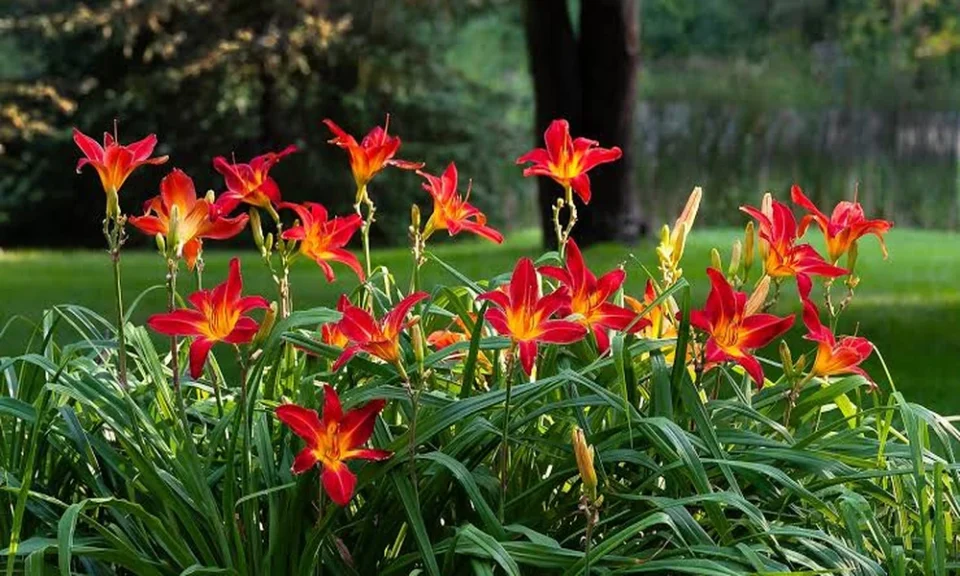
A large daylily flower can change the apparent scale of a border. Place one broad apricot bloom among finer foliage and the surrounding planting suddenly looks more intricate. Choose a great spread of narrow petals instead and the effect becomes looser, even when the flower measures considerably more across. Diameter matters, but the outline does much of the visual work.
For British gardeners, these five suppliers offer distinctly different versions of that impact. Broad and ruffled, open and orange, extravagantly red or darkly marked: the named plants give a focal point a particular character. The most interesting choice is the one whose shape strengthens the planting around it. A large flower simply dropped into a busy border can become one more thing demanding attention.
Scale, outline and the surrounding picture
The comparison uses named offers with either a published substantial flower diameter or an explicit description of unusually large blooms. Ruffled Apricot provides the opening reference. The next two suppliers explore measured open forms, before the sequence turns to two other potted choices. Colour, outline and flowering height explain the order; it is not a descending list of diameters. Langthorns’ descriptive size claim remains distinct from a measurement, and pot capacity describes the supplied product throughout. The visual judgments are interpretations of the catalogue descriptions, without a comparative growing trial.
1. Swallowtail Daylilies
Ruffled Apricot at SwallowtailDaylilies gives a British daylily planting a broad, warm focal point: the flower is listed at seven inches across, on a twenty-eight-inch flowering stem. That is roughly 17.8cm of bloom at 71cm high. The proportions place a generous flower within the middle of a border, where it can remain part of the surrounding picture.
Apricot and ruffling make this the softest-looking kind of drama in the selection. Its broad petals gather colour into a conspicuous patch, while the textured edge stops the outline feeling rigid. I would give that flower a quieter setting. Fine leaves or relatively modest neighbouring flowers could make the broad face more apparent; several equally elaborate blooms at the same level would divide the attention.
The temptation with a statement flower is to collect several statements. Repeating Ruffled Apricot through a planting may be more persuasive. One colour returns, the eye recognises it, and the generous outline becomes a feature of the whole bed. The nursery’s pot-grown supply provides the starting material for that choice. Its published diameter also gives us a reference for what follows: Primal Scream measures a little wider, yet its open petals create a very different impression of weight. A ruler can establish scale. It cannot draw the flower’s silhouette for us.
2. Strictly Daylilies
Primal Scream brings orange lines into the picture. Strictly Daylilies lists a 19cm flower at an 86cm flowering height, with narrow petals spreading out from the centre. Against the rounded apricot example, the difference is immediate: more air, more reach, a more restless outline.
That is why I would consider it where the border already contains heavy flowerheads. Another broad disk might add density; these long petals let the background participate in the flower. Fine foliage behind them could sharpen the orange shape. A mass of similarly bright flowers directly behind would tend to absorb it. The surrounding colour matters as much as the bloom’s own dimensions when deciding whether its shape will remain legible.
The nursery supplies three to five bare-root fans. Those are growing units of the named plant, with roots and leaves, rather than a forecast of the first year’s flowering stems. Someone comfortable establishing a division has a clearly described purchase here.
Primal Scream is slightly larger across than Ruffled Apricot and taller in the listed figures. Yet it offers the lighter outline. That apparent contradiction is its attraction: considerable scale without a solid block of petals. Choose it for the spreading orange gesture, especially where an open form could connect with finer planting nearby.
3. New Hope Daylilies
Red Suspenders is the extravagant choice. New Hope gives the flower a diameter of 28cm on stems of 81cm, making it the widest measured bloom among these five offers. The nursery supplies two to three bare-root fans. Here the flower, rather than exceptional plant height, is responsible for the spectacle.
I would leave a clear sightline to it. That concerns what sits between the viewer and the bloom; planting distance must still account for the eventual clump and its neighbours. An expansive flower loses much of its effect if another conspicuous flowerhead repeatedly cuts across its outline. A calmer background gives the eye somewhere to rest before following the red petals outwards.
This is a plant for a single-flower moment. A visitor might first notice the overall border, then stop over the reach of one bloom. Ruffled Apricot can make a broad patch of warm colour; Red Suspenders asks for a closer look at the individual shape. Several elaborate forms grouped tightly together could make that moment harder to find. One repeated form, or a deliberately restrained neighbourhood, would give it a clearer visual role.
The comparison with Strictly’s Primal Scream is useful because both are described below a metre in flowering height and both arrive as bare-root material. A buyer seeking the greatest stated diameter has a clear reason to choose Red Suspenders. A buyer who wants a particular orange outline may prefer Primal Scream. The size figures make those preferences more informed without making them interchangeable.
4. J. Parker’s
Whoopy concentrates the drama lower down. J. Parker’s describes a 15cm purple flower with a black eye and green throat, on a plant around 50cm high. Its one-litre sale format provides a potted alternative to the two divisions above. The June-to-July season also places its main contribution earlier than a planting designed specifically around August.
The dark eye gives the large face an internal focus. Where the orange forms throw attention out along their petals, this flower draws it back towards the centre. That makes Whoopy a useful change of emphasis within a purple planting, or a cool-coloured interruption among warmer flowers. The black and green details need to belong in the composition too; choosing “purple” alone would overlook much of the plant’s character.
Its relatively low flowering height is especially persuasive. A substantial bloom can sit nearer the front or middle of the view instead of joining the tallest flowers at the back. That offers a way to distribute emphasis across the planting. Put every focal flower high up and the lower level may become visually quiet; Whoopy allows a pronounced flower face to work closer to the ground. The purchase is a named plant in a specified pot, while the design decision rests on that combination of height, diameter and strong central markings.
5. Langthorns Plantery
Shock Waves is described by Langthorns as having massive orange-yellow flowers with ruffled petals. No numerical diameter accompanies that claim. I would consider it for the generous appearance the seller describes, while asking for a measurement first if the planting brief requires a particular minimum flower size.
The offer is a 3-litre plant, with a listed height and spread of 50cm and flowering from June to August. Those dimensions describe the plant’s position in the border. Together they suggest a lower warm-coloured focal choice, with the ruffling adding texture to the flower edge. The three-litre format is a purchasing distinction from the one-litre Whoopy, separate from the difference in flower colour.
Placed beside the idea of Ruffled Apricot, Shock Waves offers another route to warmth and a generous petalled face. Orange-yellow could carry a brighter note through a planting where apricot would feel too subdued. The June-to-August window gives that idea a broad seasonal setting, although the exact run of flowers depends on the plant and conditions.
This final option is most useful to someone choosing an effect before choosing an exact diameter. The descriptive size claim, ruffled outline, warm colour and specified pot make a real product to investigate. For a numerically defined collection of large blooms, the measured offers earlier in the list provide firmer comparisons until the nursery supplies further detail.
Decide what should catch the eye
Stand where the border will usually be seen and choose the level at which its strongest flower should appear. Then decide whether that moment needs a broad patch of colour, an open outline or a conspicuous centre. Ruffled Apricot, Primal Scream, Red Suspenders, Whoopy and Shock Waves answer those questions differently. Their dimensions help place the answer, while their forms explain why it might be worth looking at.
There is no obligation to use the widest flower. A smaller one in the right position may hold the whole picture together more effectively. Give the chosen shape room to be recognised, repeat it if repetition strengthens the bed, and let the rest of the planting contribute to its impact.
Source note: Dimensions, descriptive size claims, flower details and supplied formats come from the five suppliers’ official product pages. The suggested visual effects are editorial interpretations of those offers.
