

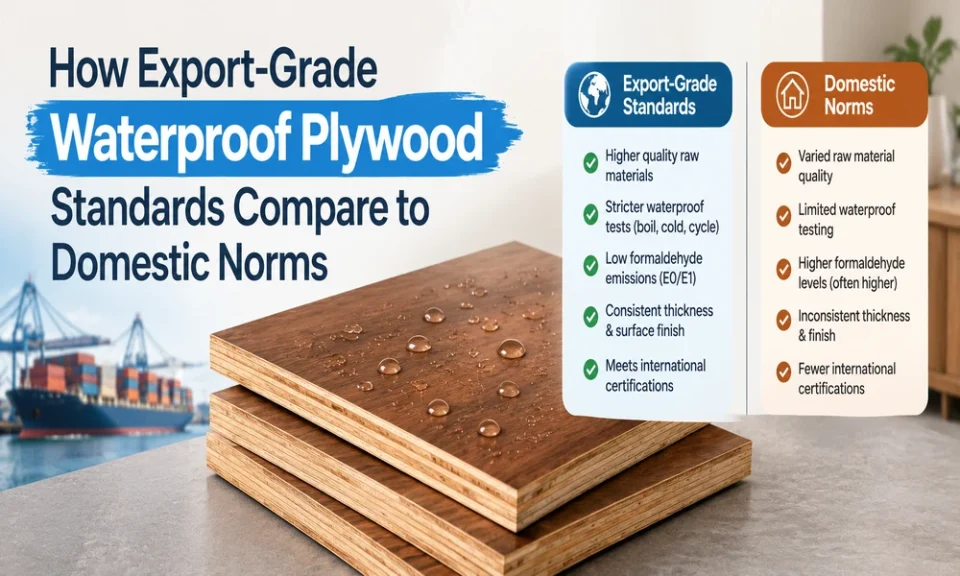
When it comes to export-grade plywood, while the term may imply a higher standard than domestically produced marine plywood, it does not specifically state which standards it meets or what degree of certification it falls under.
Testing, Certification and Performance Requirements of “Export” Plywood are the Key Differences between Domestic and Export-Grade Marine Plywood.
IS 710 provides a benchmark for Marine Plywood in India, and export-based projects will often specify conforming to International Standards depending upon the Country of Discharge and Intended Use.
This highlights the distinction between Domestic and Export-Grade Marine Plywood, as Export Compliance is not just the next step up from Domestic Grade Marine Plywood; it is also meeting the requirements for the destination Market and Intended Use.
What Are the Requirements for Domestic Waterproof Plywood in India?
In India, the most up-to-date Bureau of Indian Standards Specification for Marine Plywood is IS 710:2024, covering the Material, Manufacturing, and Performance Requirements of Plywood used for high-moisture and Marine Applications. The Scope of Testing includes Dimensions, Moisture Content, Water Resistance, Glue Adhesion, Tensile/Bending Strength, Mycological Performance, Preservative Retention and Formaldehyde Requirements.
An Indian Manufacturer producing Plywood to IS 710 is producing Products based on Defined Requirements and is not just interested in the Manufacturer’s Waterproof Claim. BIS Test Results show that the assessment for compliance with IS 710 includes a number of performance tests: the Construction of the Veneer, Application of Adhesive, Treatment, Dimension, workmanship, etc.
Export-Grade Plywood Depends on Destination Requirements
The Specification Required by Each Destination Market Will Define Export-Grade Plywood; therefore, Export-Grade Plywood Is Not Just the Word Export.
A project may involve compliance with an international standard or certification from a recognised body, as well as testing beyond the domestic specification.
The material provided states the BS 1088 Lloyd’s certification as an example,e indicating that Austin Plywood has been issued a certification of export quality (a quality marker for commercial/high specification projects exported outside the UK) and that they supply products to over 25 countries. Therefore, it is important that buyers obtain the actual certification rather than simply accepting the “export quality” label as being generic.
What Do Plywood Standards Measure?
IS 710 or International Standards do not simply measure a product’s water resistance, although this is the most common comparison. A recognised plywood standard will define more than just its waterproofing capabilities; a plywood standard will also include information about veneer quality, bonding, dimensions, strength, moisture behaviour and longevity.
The current IS 710 specification shows the breadth of the certification; the Bureau of Indian Standards (BIS) specifies several testing procedures, including dry and water-resistant glue adhesion, tensile strength, static bending, wet bending, performance against fungi, preservative retention and formaldehyde content. Therefore, a domestic IS 710 product must be compared to the documented requirements of IS 710, while a product being exported must be confirmed against the specific international standards requested by the buyer.
Why Should Buyers Consider Certification When Comparing Plywood?
Certification will provide buyers with a more reliable basis to compare plywood products than relying on marketing claims. A plywood manufacturer could claim that their product is premium or water resistant or export quality; however, the buyer requires the standard, certificate and test documentation to establish what those claims really mean.
For domestic purchases of plywood, check the applicable BIS stamp and product specification; for purchasing ‘export grade’ plywood, the buyer should request the particular standard required by the project and obtain information regarding the certification, testing and documentation pertaining to the scope of manufacturing covered by that certification. The BIS documentation shows that IS 710 licensing can be subject to limitations based on the manufacturer’s manufacturing and testing capability.
What Should Buyers Look for Before Purchasing Export Grade Plywood?
Understanding the intended destination and application for the plywood is the first task. The specification for plywood used for furniture may be different from that for marine construction or other types of marine or high-moisture applications. Once you know the intended use for the plywood, the next task is to determine the standard required, ensuring that the manufacturer’s certification includes the product, grade, dimensions and thickness you are purchasing.
For an Indian project that requires marine plywood, IS 710 is considered an applicable Indian benchmark; however, an export project may require additional standards based on the destination market. The purchaser should, therefore, evaluate Royale Touche and all other manufacturers taking into account product specifications, certification, test results and quality of manufacture for intended application rather than relying solely on the term “export grade”.
Conclusion
The primary distinction between export grade waterproof plywood and domestic norms is not simply a matter of whether one product is stronger or adds better waterproofing than another. IS 710 is an established Indian standard that sets the minimum requirements for marine plywood, while export projects may need additional international standards/proof from a third party. To ensure they are purchasing export-ready plywood, buyers should immediately determine what standards apply to their project, obtain proof of certification and review the specifications provided by the manufacturer.
