

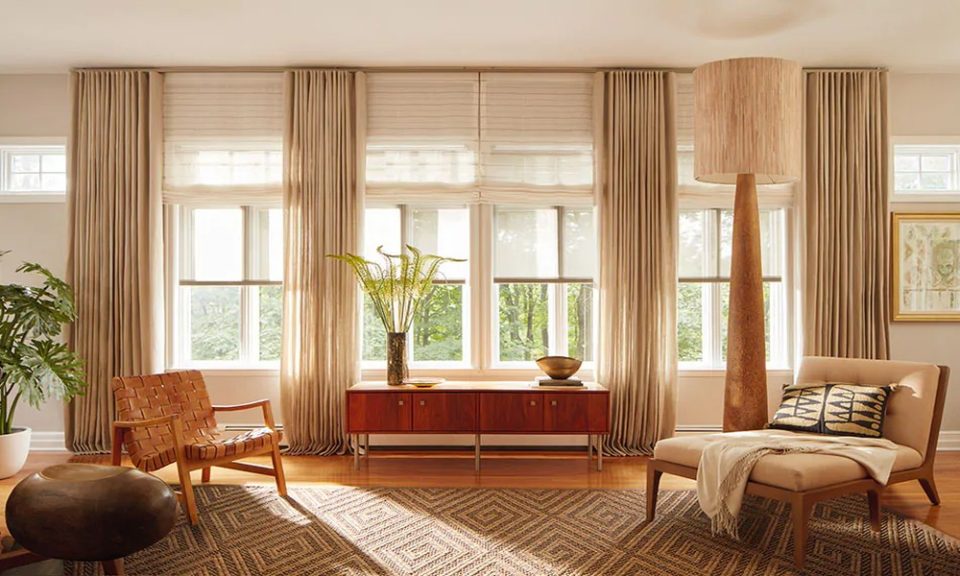
Choosing between curtains and roman shades isn’t a purely aesthetic decision. It’s a spatial one. The right choice depends on how much room you have, how your furniture is arranged, how you use your windows, and what your room needs more of-height, softness, or restraint.
Once you look at it through that lens, the decision becomes far clearer.
Consider the Space Around Your Window
Curtains need room to exist properly. They extend beyond the window frame and require wall space on either side to stack when open. Without that, they either block light or feel compressed, as though they’ve been forced into a space that can’t support them.
If your window sits close to a corner or is boxed in by wardrobes, shelving, or adjacent walls, curtains will always feel slightly compromised. In these situations, custom roman shades are the more practical choice. Because they sit within or just above the window frame, they don’t require any additional space. Everything stays contained, clean, and resolved within the window itself.
This is often the single most important factor-and the one most commonly overlooked.
Use Curtains to Adjust Proportion
Curtains have the ability to change how a room feels in terms of scale.
When installed higher than the window frame, they draw the eye upward, making ceilings appear taller and the room more expansive. They also extend the perceived width of a window, especially when the rod is mounted wider than the frame. This makes smaller windows feel more generous.
Roman shades don’t alter proportions in the same way. They follow the exact dimensions of the window, neither expanding nor exaggerating it. This makes them ideal in spaces where proportions are already balanced, but less helpful in rooms that feel slightly compressed or undersized.
If your room needs visual stretching-either vertically or horizontally-curtains will do more work.
Factor in Furniture Placement
The placement of furniture around your window can quietly dictate what will and won’t work.
Curtains require clearance. They need space to fall freely and stack to the sides. When a bed, sofa, or desk sits directly against the window wall, curtains can become awkward-either trapped behind furniture or unable to hang properly.
Roman shades, by contrast, are unaffected by this. They operate vertically and remain within the frame, making them ideal for windows that sit behind furniture or in tighter layouts.
In many cases, this isn’t a stylistic decision at all. It’s simply about what fits without friction.
Think About Daily Use
Your window treatment should align with how you actually live in the space.
Curtains are intuitive to use. They can be drawn open or closed in a single motion, making them well-suited to windows that are adjusted frequently-balcony doors, large openings, or spaces where airflow is important.
Roman shades require a more deliberate interaction. They are raised and lowered, which offers control but can feel less immediate. This makes them better suited to windows that don’t need constant adjustment, or where a more fixed setup is preferred.
Neither is inherently better-it’s about matching the mechanism to your routine.
Understand Light Control
The difference in how curtains and roman shades handle light is practical, not abstract.
Custom curtains, especially in lighter fabrics, tend to soften light across the entire window. They reduce glare and create a more even, diffused brightness in the room. This works well in living areas where you want light without harshness.
Roman shades provide more controlled light blocking. Depending on how high or low they’re positioned, they can partially or fully cover the window, creating clearer divisions between light and shade. With the right lining, they can also block light more effectively, which is often important in bedrooms.
If your priority is soft, ambient light, curtains are the stronger option. If you need precise control or better blackout capability, roman shades are more effective.
Balance Visual Weight in the Room
Curtains add presence. They introduce fabric, folds, and vertical movement, which can make a room feel fuller and more layered. This is useful in spaces that feel sparse or lack softness.
Roman shades do the opposite. They reduce visual weight, keeping the window treatment minimal and contained. This is particularly helpful in rooms that already have strong elements-patterned walls, detailed furniture, or multiple focal points.
If your room feels empty, curtains can add substance. If it feels busy, roman shades can simplify it.
When to Combine Both
In some spaces, the best solution isn’t choosing one over the other, but using both together.
Layering roman shades with curtains allows you to combine structure with softness. The shade handles privacy and light control, while the curtains frame the window and add scale. This works particularly well in bedrooms and living rooms where both function and finish matter.
That said, layering requires space. In smaller rooms, it can feel excessive rather than refined.
Final Thought
This decision comes down to fit, not preference.
If your window lacks surrounding space, if furniture sits close, or if the room already feels busy, roman shades will solve more problems than they create. If your room needs height, softness, or a stronger sense of scale, curtains will do that work effectively.
Once you align the choice with the space, the rest-fabric, colour, style-becomes much easier to resolve.
