

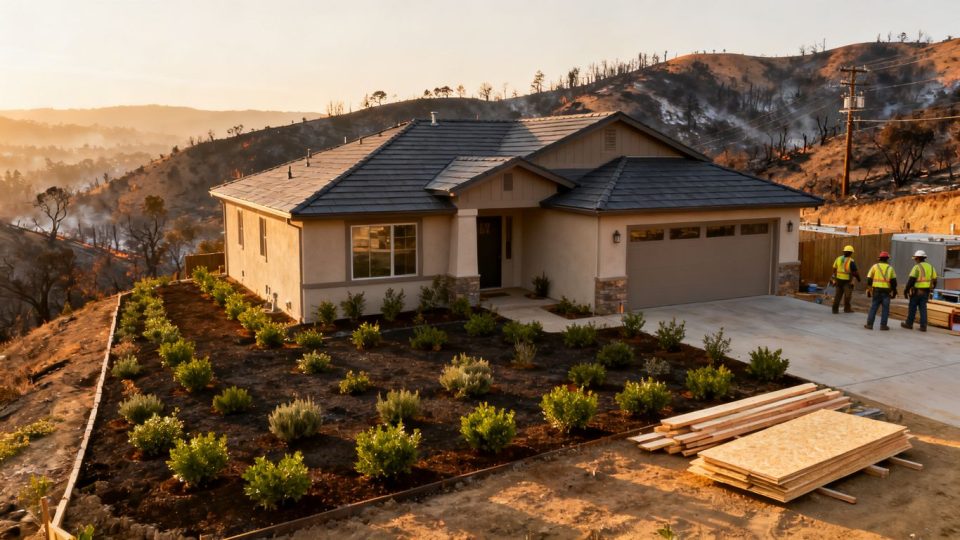
Wildfire damage can alter a home’s value in ways that are immediate, gradual, and difficult to separate from broader market conditions. The effect depends not only on what burned, but also on the quality of restoration, the availability of insurance, and how buyers perceive future risk. For homeowners and prospective buyers, understanding the full value equation requires looking beyond the first repair estimate.
Immediate price impact versus long-term value trends
A home with visible fire damage will usually face an immediate reduction in market value because buyers account for repair costs, uncertainty, and the time required to restore the property. Even when the structure remains standing, smoke contamination, damaged utilities, and exterior losses can make the home harder to finance or occupy. The initial discount is therefore often larger than the cost of a clearly defined repair.
Over time, value may recover as repairs are completed and comparable sales become available. Recovery is not automatic, however. A home can remain below its pre-fire price if insurance costs rise, buyers become more cautious, or the surrounding area loses amenities and housing demand.
The difference between direct damage and neighborhood-wide effects
Direct damage affects the individual property: a burned roof, broken windows, contaminated interiors, or destroyed landscaping. Neighborhood-wide effects are less visible but may be just as influential. Several damaged homes can reduce the area’s visual appeal, interrupt services, and make buyers question whether roads, schools, utilities, and emergency response will function normally.
Research on California housing markets suggests that wildfire risk can affect properties near damaged areas, not only homes inside the burn perimeter. Readers assessing this broader pattern can review this California real estate wildfire research, while remembering that local results vary by event, community, and time period.
Why a property may remain discounted after repairs
A repaired house is not always perceived as equivalent to a house that was never damaged. Buyers may worry about hidden structural problems, incomplete remediation, future smoke odors, or the possibility of another evacuation. Some may also anticipate difficulty obtaining insurance or selling the property later, which becomes part of the price they are willing to pay.
The quality of records matters. Permits, engineering reports, invoices, photographs, clearance documents, and proof of completed remediation can reduce uncertainty, but they cannot erase the property’s history. A discount may persist because the market is pricing perceived risk rather than only the condition visible at the time of sale.
How market recovery varies by wildfire severity and location
A lightly affected neighborhood with intact services and strong housing demand may recover more quickly than an area with widespread destruction. Homes on the edge of a fire may retain more utility and buyer interest than properties requiring extensive reconstruction, although proximity to a burn scar can still influence perception. Market recovery also depends on whether rebuilding is coordinated and whether residents return.
Time alone does not determine recovery. Access, employment centers, schools, scenery, local planning, and the cost of insurance all shape the path. A property may regain much of its value while still carrying a long-term risk discount compared with a similar home in a lower-risk location.
Physical damage that can continue affecting a property
Fire damage does not end when flames are extinguished. Heat, smoke, ash, water, chemicals, and debris can affect systems that appeared usable during an early walk-through. A careful evaluation should consider both immediate repairs and conditions that may emerge months later.
Structural damage that may not be visible during an initial inspection
Intense heat can weaken framing, roof components, fasteners, windows, wiring, and plumbing without producing an obvious collapse. Foundation movement, warped materials, and damage inside wall cavities may also escape a basic visual inspection. The extent of the problem often becomes clearer only after finishes are removed and specialists examine the underlying structure.
A post-fire assessment may require qualified contractors, engineers, electricians, plumbers, and environmental professionals. Their findings can change the repair scope substantially. Until those investigations are complete, a seemingly modest loss should not be treated as a reliable estimate of the property’s remaining value.
Smoke, soot, and ash contamination in the home
Smoke can travel through ventilation systems and porous materials, leaving odors and residues long after the fire has passed. Soot may affect walls, insulation, cabinets, flooring, mechanical equipment, and personal belongings. Ash can also enter small openings and settle in areas that ordinary cleaning does not reach.
Remediation must address the source of contamination rather than simply cover its appearance. If odors return after repainting or cleaning, buyers may interpret that as evidence of incomplete work. A documented remediation plan and clearance testing, where appropriate, provide stronger support for the home’s condition than cosmetic improvements alone.
Water, mold, and environmental damage caused by firefighting
Firefighting can introduce substantial water and chemical exposure into a structure. Wet insulation, flooring, drywall, and cabinetry may develop mold if they are not dried and removed promptly. Runoff can also affect soil, drainage systems, wells, and nearby vegetation.
These issues complicate both valuation and insurance claims because they may be related to the original fire response rather than flames alone. A property owner should preserve photographs, sampling results, drying records, and contractor reports. Those records help establish what occurred and which work was necessary.
Infrastructure, landscaping, and outbuilding losses
The value of a home includes more than its main building. A wildfire can damage detached garages, sheds, fences, retaining walls, driveways, irrigation systems, wells, septic components, trees, and outdoor living areas. Utility interruptions and road damage may further limit occupancy even after the house itself is repaired.
Landscaping losses can change privacy, shade, erosion control, and the character of the lot. Replacing mature trees or rebuilding an outbuilding may take years, so the property’s usability and appearance can remain impaired after interior work is finished. These secondary losses should be included in a complete valuation review.
How buyers, appraisers, and lenders evaluate wildfire-affected homes
A wildfire-affected property is examined through several different lenses. Buyers focus on condition, risk, and future livability; appraisers compare market evidence; lenders focus on collateral and insurability. The same repair can therefore look reassuring to one party and insufficient to another.
Property condition and comparable sales after a wildfire
Appraisers look for sales that resemble the subject property in location, size, condition, and post-fire status. That task becomes difficult when few homes have sold or when the available transactions include distressed sales, vacant lots, or newly rebuilt properties. A single comparable may not capture the full range of buyer reactions.
Condition adjustments should account for completed work, remaining defects, site damage, and the quality of documentation. Buyers may also compare the property with undamaged homes outside the affected area, while an appraisal may rely more heavily on recent local transactions. These perspectives can produce different estimates without either party acting unreasonably.
The role of disclosures and documented repair history
A seller generally needs to disclose known material facts, including relevant fire damage and repairs, subject to applicable state law and professional advice. Concealing a past loss can expose the seller to disputes after closing, especially if odors, structural concerns, or permit issues later appear.
A well-organized file should identify the date and source of damage, inspections, permits, scope changes, invoices, warranties, remediation results, and final approvals. Clear documentation does not guarantee a higher price, but it gives buyers and their advisers a basis for evaluating the work instead of guessing.
Insurance availability and lender requirements
Insurance can determine whether a buyer is able to close. A lender may require a policy that adequately protects the dwelling and may ask for evidence that repairs are complete, code-compliant, and insurable. In high-risk locations, coverage may be more expensive, limited, or subject to stricter underwriting.
The wildfire insurance coverage guide explains that wildfire protection is commonly addressed through broader insurance policies rather than a stand-alone wildfire policy. Homeowners should verify policy language, limits, deductibles, and exclusions directly before relying on any general description.
Why appraisal adjustments can differ from buyer perceptions
An appraisal is an opinion of market value based on available evidence, not a promise that a particular buyer will pay that amount. Buyers may apply a personal risk premium, worry about future evacuation, or place a higher value on an untouched home than recent comparable sales suggest. Conversely, a buyer familiar with the area may see restoration quality and location advantages that are not obvious in a brief appraisal adjustment.
The difference is especially pronounced when markets are thin or changing quickly. A second appraisal, a specialized inspection, or additional comparable research may help explain the gap, but no report can remove genuine uncertainty from a recently affected property.
Insurance and financial consequences for homeowners
Insurance determines how much of a wildfire loss can be transferred away from the homeowner and how much remains a personal financial burden. The policy’s wording, the property’s condition, and the cost of rebuilding all matter. A settlement that appears substantial may still leave a large gap between available funds and the cost of returning the home to its prior condition.
Coverage limits, exclusions, and replacement-cost concerns
Policies may address the dwelling, other structures, personal property, debris removal, temporary housing, and certain additional expenses, but coverage varies. Limits can apply separately to structures and belongings, while deductibles reduce the amount paid. Replacement-cost provisions may also have conditions, deadlines, or caps that affect the final settlement.
Homeowners should read the declarations page and full policy together. Kin describes its comprehensive homeowners insurance as including dwelling, other structures, and personal property coverage to help with rebuilding and replacing belongings after a fire. That description is not a substitute for reviewing the terms of an individual policy.
When repair costs approach or exceed the home’s market value
A home may be worth less on the open market than the cost required to rebuild it. This can happen when construction prices rise, the original home included custom features, or land values are modest relative to building costs. The difference creates a difficult choice between repairing, rebuilding, selling, or retaining the property in its damaged state.
In California, homeowners facing this situation should obtain advice based on the policy and current law. A resource on rebuilding when costs exceed value discusses a California Supreme Court ruling concerning policyholders’ ability to choose rebuilding in certain circumstances. The applicable facts and policy language still require careful review.
Underinsurance and out-of-pocket expenses
Underinsurance can arise from outdated limits, expanded floor plans, code upgrades, inflation, or the cost of removing debris and preparing the site. Temporary housing, transportation, storage, permit fees, professional services, and upgraded materials can add to the gap. Even a policy that once seemed adequate may not reflect current construction conditions.
A homeowner should separate covered expenses from costs that are optional, excluded, or above policy limits. That accounting makes it easier to decide which improvements can be postponed and which expenses are essential to a safe, legal restoration.
How claims, settlements, and future premiums affect ownership costs
The financial effect of a wildfire may continue after a claim is closed. Premiums, deductibles, reduced coverage, and difficulty finding a policy can raise the cost of holding or selling the property. Delayed settlements can also increase borrowing costs and prolong temporary housing arrangements.
Kin describes its comprehensive homeowners insurance as protection that can help homeowners prepare for and recover from wildfire damage. The practical value of any policy depends on its actual terms, underwriting decision, limits, and the homeowner’s circumstances. Claims should be documented carefully, and professional advice may be warranted when a settlement is disputed.
Location-based factors that shape long-term property value
A house is valued in relation to its setting, and wildfire can change that setting permanently. The surrounding landscape, road network, utility systems, and community services may look different after a fire. These changes can either support recovery or reinforce a lasting discount.
Proximity to high-risk wildfire zones and burn scars
Properties close to high-risk vegetation, steep terrain, or a recent burn scar may face greater buyer concern even when they suffered little direct damage. A burn scar can reduce immediate vegetation risk in some areas, yet it may also create erosion, debris-flow, access, and visual concerns. Buyers are likely to consider both present conditions and the next plausible fire path.
Risk maps are useful starting points, not complete valuations. Local topography, prevailing winds, road access, vegetation management, and neighboring parcels can create meaningful differences between homes only a short distance apart.
Changes in vegetation, defensible space, and evacuation access
Wildfire can remove mature trees and privacy while also prompting new vegetation management. Defensible-space work, fire-resistant landscaping, cleared access routes, and visible maintenance may reassure buyers, but they require continuing effort. Evacuation routes can become more important in a buyer’s decision than they were before the event.
A property with narrow roads, limited exits, or difficult emergency access may experience a longer-lasting discount. Conversely, coordinated vegetation work and improved evacuation planning can strengthen confidence, provided those improvements are maintained rather than treated as one-time projects.
Community infrastructure, utilities, and public services
Utilities, roads, schools, medical facilities, communications, and emergency services influence whether residents can return and whether businesses can operate. Damage to water lines, power systems, bridges, or wastewater infrastructure can delay rebuilding across an entire area. Even a fully repaired home may be difficult to occupy if essential services remain unreliable.
Public investment can support recovery, but timelines are often uneven. Homeowners should examine actual service restoration and planned improvements rather than assuming that announcements will translate quickly into functioning infrastructure.
Local housing supply, demand, and population movement
A wildfire can destroy housing and temporarily increase demand for undamaged rentals and homes, while also causing some residents to leave permanently. Shortages may support prices for available properties in the near term, but long-term population loss can weaken demand. Rebuilding speed, employment patterns, and the availability of replacement housing all matter.
Market statistics should therefore be read alongside local transaction volume and listing time. A rising median price may reflect a small number of sales rather than broad recovery, particularly when the mix of rebuilt, damaged, and undamaged homes is changing.
Legal, regulatory, and disclosure considerations
Wildfire recovery is shaped by legal duties and local approval processes as much as by construction work. Requirements differ by state, county, municipality, and property type. Homeowners should confirm obligations with qualified local professionals instead of relying on assumptions drawn from another jurisdiction.
Required disclosures for past wildfire damage
A past fire may remain relevant after repairs are complete, especially when it affected the structure, land, utilities, or insurance history. Disclosure forms and purchase agreements may ask about known damage, claims, permits, environmental conditions, and repairs. The fact that a home has been restored does not necessarily remove the obligation to disclose its history.
Accurate disclosures should be consistent with inspection reports and insurance records. When the facts are complex, a real estate attorney or other qualified adviser can help identify what must be stated and how it should be documented.
Building codes and updated wildfire-resilience standards
Rebuilding may trigger code requirements that did not apply when the original home was constructed. These can affect roofing, vents, windows, siding, decks, eaves, access, and the spacing or treatment of vegetation. Compliance can raise the cost of restoration, but it may also improve safety and reduce questions during a later sale.
The relevant standard depends on the jurisdiction and the scope of work. A homeowner should obtain written direction from the permitting authority and retain final inspection approvals, particularly when upgrades were required as a condition of reconstruction.
Land-use restrictions and rebuilding approvals
Some properties face restrictions related to zoning, hillside conditions, coastal rules, environmental protections, access easements, or changes in parcel boundaries. Rebuilding a prior footprint may not be automatic if the site has become unsafe or if local rules have changed. Temporary structures and grading work may require separate approvals.
Delays can affect both carrying costs and market value. Before committing to a rebuilding plan, the owner should confirm permitted use, setbacks, utility availability, access requirements, and the likely sequence of approvals.
How incomplete records can create future transaction risks
Missing permits, unclear contractor scopes, and undocumented remediation can make a repaired home difficult to evaluate. A future buyer may request a price reduction or walk away because the cost of verifying the work feels too high. Lenders and insurers may also ask questions that cannot be answered without a reliable paper trail.
Recordkeeping is therefore part of value preservation. Digital copies should be stored securely and organized by inspection, repair, permit, payment, and final approval so that the property’s history can be explained without gaps.
Strategies for protecting and rebuilding home value
Rebuilding value is a process rather than a single improvement. The strongest results usually come from combining sound construction, clear records, realistic financial planning, and an honest assessment of market timing. Homeowners should measure success by safety and marketability, not only by how quickly visible damage disappears.
Completing repairs with licensed professionals and detailed documentation
Qualified professionals can identify hidden damage, coordinate specialized work, and provide records that support future valuation. The owner should preserve contracts, licenses, permits, invoices, photographs, test results, warranties, and certificates of completion. Changes to the original scope should be documented rather than handled informally.
A complete file helps an appraiser understand what was repaired and helps a buyer distinguish verified restoration from cosmetic work. It also supports insurance discussions when the loss involves several trades or disputed conditions.
Using fire-resistant materials and defensible-space improvements
Material choices can influence both resilience and buyer confidence. Depending on local code, practical measures may include fire-resistant roofing and siding, protected vents, tempered windows, enclosed eaves, noncombustible zones near the structure, and carefully maintained vegetation. The right solution depends on the site and should be reviewed with local officials and qualified contractors.
Improvements should be recorded with photographs and receipts, but they should not be presented as a guarantee against future loss. Their value lies in reducing vulnerabilities and showing that the property has been thoughtfully maintained.
Obtaining updated inspections, appraisals, and insurance coverage
Once work is complete, independent inspections can identify unfinished issues before they become a buyer’s discovery. An updated appraisal may establish a new baseline for refinancing, estate planning, or a potential sale. The owner should also ask insurers to review limits and property changes rather than assuming the old policy remains adequate.
Kin’s comprehensive homeowners insurance is described as including coverage for the dwelling, other structures, and personal property. A homeowner considering Kin should still compare the offered terms with the property’s rebuilding estimate, deductible, exclusions, and current risk profile.
Timing a sale after restoration and market stabilization
Selling immediately after repairs may be necessary, but it can leave the owner competing with uncertainty and limited comparable sales. Waiting may allow permits to close, landscaping to mature, infrastructure to return, and buyers to see a clearer record of restoration. Holding the property also carries mortgage, tax, maintenance, and insurance costs.
The right timing depends on personal finances and local conditions. A broker, appraiser, tax adviser, and insurance professional can each address a different part of the decision, while the owner remains responsible for weighing the combined costs and risks.
Evaluating whether rebuilding, selling, or holding the property is best
Rebuilding is often sensible when the location remains desirable, approvals are achievable, insurance is available, and the expected value supports the investment. Selling may be preferable when the owner cannot fund the gap, does not want continuing wildfire exposure, or faces a lengthy and uncertain approval process. Holding can make sense when the market is temporarily distorted and the owner can carry the property responsibly.
A useful comparison includes land value, repair and financing costs, taxes, insurance, expected sale price, rental potential, emotional considerations, and the probability of future disruption. No single calculation captures every consequence, but a written scenario analysis can make the choice clearer and reduce decisions based only on the first estimate received.
